
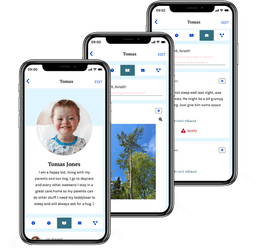

JodaCare follows the child.
JodaCare brings together the child's everyday life across every transition, from birth home to foster home and contact visits.
Together on what matters most
JodaCare and Mai Life complement each other. Together we cover two sides of child welfare:
Mai Life takes care of the case
JodaCare takes care of the child
Does this sound familiar?
Many adults, fragmented picture
Around every child there is a case worker, foster carers, birth parents, teacher and child psychiatry, and each of them sees their part of daily life without knowing what the others see.
Documentation steals time from the child
Much of a case worker's day goes to writing, reading and relaying information that could have been spent on time with the child instead.
Email and SMS are not secure enough
Sensitive information about children ends up in private inboxes and chat threads, and that is a way of working that has no place in child welfare.
Audit trail is incomplete
When a case needs review, or when it ends up in court, traceability must be in place from the very first day.
How it fits together
Coming Q2 2027The child is at the centre, and around it are four roles with clearly defined boundaries.
Case worker
Foster carer
Birth parent
Support person
The four roles and the information barriers between them arrive with the child welfare and contact module.
Features for the daily work
Contact plans with status flow
Coming Q2 2027Boka from the foster home
Available nowEvent log
Coming Q4 2026Jodabook for children with special needs
Coming Q1 2027Information barriers
Coming Q2 2027Audit log
ComingWe have deep experience with "many adults around one child"
JodaCare has been in production at Norwegian municipalities since 2016. Much of the structure in child welfare can be found in the adjacent segments we already deliver to.
Horten municipality since 2016
Respite care and cognitive challenges
Built with the professional groups that use it
What you get in return
Efficiency becomes meaningful when the time saved is spent on the child.
Less time on documentation.
When everyday life is documented in one place, case workers can spend their time talking to the child instead of searching for information.
Fewer coordination meetings.
When information is collected in one place, case workers no longer need to phone around to build an overview before every single meeting.
Faster onboarding of new foster carers.
The platform is already in place, and new foster carers are invited straight in without having to learn the municipality's own systems from scratch.
Less double reporting.
What is written once is read by everyone who should read it, without forwarding or manual Excel sheets.
We have not measured these effects specifically for child welfare yet. The figures above are experience from Horten municipality in personal assistance since 2016, where the structure is very similar. That is one of the reasons we are now seeking pilot municipalities in child welfare.
A childhood that can be remembered.
Many adults who grew up with child welfare interventions say their childhood memories are unclear. They do not always remember where they were when, who the adults around them were, or whether they had holidays that year. JodaCare follows the child, and at the same time gathers a story the child can own.
“Written documentation is central to safeguarding the individual's legal rights, but also important for ensuring the child's opportunity to become familiar with their own history.”
Daily life, gathered in one place
Photos from the foster home, notes from respite care and contact visits that were carried out are gathered in one place and follow the child onward through each transition, each new foster home and each new case worker.
A life story the child can ownComing Q2 2027
The life story will gather daily content into one coherent story. KAI, JodaCare's Norwegian AI guide, will be able to help write it. KAI: Coming. When the child is ready, whether as a teenager or as an adult, there will be something to read and lean on.
Access when the child needs it
Children over 15 have their own right to access their case, and JodaCare gives the child a structured way into their own history. That right also applies as an adult, when the questions about childhood come.
Grounded in the Child Welfare Act § 12-4 (record-keeping obligation), the Participation Regulation §§ 4–6 and NOU 2023: 7 "Safe childhood, secure future", chapter 21 on children's need for continuity.
Built for Norwegian public administration
ID-porten
Sign-in through ID-porten at security level substantial, with MinID, BankID, Buypass or Commfides.
All data in Europe
The database and services run in Stockholm. The AI features that are coming will use Mistral in Paris.
GDPR compliant
The platform is built with GDPR principles embedded from the first day, and a formal data protection impact assessment will be completed before the first commercial child welfare pilot.
Legally grounded
Child welfare and contact is developed on the basis of the Child Welfare Act, the Public Administration Act and the Norm.
How JodaCare for child welfare is being built
The child welfare module is built on the core module in the new JodaCare and is adopted in stages together with pilot municipalities.
NOK 35,880 per year for up to 10 service recipients, plus onboarding NOK 28,000 one off. The child welfare module is priced separately once it is finished. See all prices →
Available now
- Boka and notices
- A team around each child with role-based access
- Sign-in with ID-porten or work account
What is coming
- Event logComing Q4 2026
- JodabookComing Q1 2027
- Concern reportComing Q1 2027
- Contact module with four roles and information barriersComing Q2 2027
- Life storyComing Q2 2027
- No date yet: calendar, audit log, KAI
After first pilot
- Adaptation to the municipality's case system
- Integrations with Mai Life
- Broader rollout in more municipalities
We are looking for pilot municipalities in child welfare
Child welfare and contact: Coming Q2 2027. We are looking for a municipality willing to think with us about how this could work in practice. In a pilot, we do the work, and you provide the feedback that shapes the platform going forward.
Other parts of JodaCare that strengthen child welfare work
The platform is built so that the modules strengthen each other. These are particularly relevant when you work with children and young people.